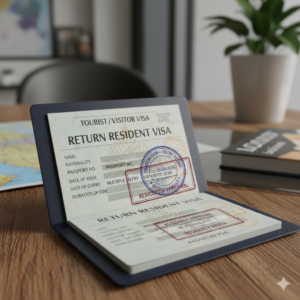
 Resident Return Visa (RRV)
A Resident Return Visa (RRV) allows current or former permanent residents of a country to re-enter and continue their residence status after travelling abroad. It is primarily used by individuals whose permanent residence travel facility has expired or is about to expire, enabling them to travel internationally without losing their residency rights.
Resident Return Visas are most commonly associated with Australia, but similar concepts exist in other countries under re-entry or returning resident visas.
Who Needs a Resident Return Visa?
An RRV is required if:
- You are a permanent resident and your travel facility has expired
- You have lived outside the country for an extended period
- You wish to return or continue living as a permanent resident
- You need to travel internationally and re-enter the country lawfully
Types of Resident Return Visas (Australia)
1. RRV (Subclass 155)
- Granted for up to 5 years if residency requirements are met
- Suitable for long-term permanent residents
- Allows multiple travel entries
2. RRV (Subclass 157)
- Granted for up to 3 months
- For applicants who do not meet full residency requirements but have compelling reasons to travel
Residency Requirements
To qualify for a long-term RRV, applicants typically must:
- Have spent at least 2 years (730 days) in the country as a permanent resident in the last 5 years
OR - Demonstrate substantial ties to the country if residency requirements are not met
Substantial ties may include:
- Employment or business ties
- Family ties
- Cultural or community involvement
- Long-term personal or economic connections
Resident Return Visa Document Checklist
Personal Documents
- Valid passport
- Previous passport(s)
- Passport-size photographs
- Permanent Resident visa grant details
Residency & Travel Evidence
- Entry and exit records
- Travel history
- Proof of time spent in the country
Substantial Ties Evidence (if applicable)
- Employment contracts or business records
- Property ownership or lease agreements
- Family documents
- Tax records or community involvement proof
Benefits of a Resident Return Visa
- Retain permanent resident status
- Travel freely in and out of the country
- Maintain access to healthcare and social benefits
- Continue pathway toward citizenship
- Avoid the need to reapply for permanent residency
Common Reasons for RRV Refusal
- Insufficient proof of residency
- Weak or unclear substantial ties
- Long absence without valid reasons
- Incomplete documentation
Our experts ensure strong representation of ties and evidence to maximize approval chances.
Our Resident Return Visa Services Include
- Eligibility and residency assessment
- Travel history evaluation
- Documentation preparation
- Substantial ties representation
- Application submission and follow-ups
- Appeal and re-application guidance (if required)
Why Choose Us?
- Extensive experience with RRVs
- High success rate in complex cases
- Personalized case handling
- Transparent and reliable support